5 Foods To Help Lower Cholesterol (with Recipes)
By Mediterranean Living
Updated September 18, 2026
Watch: 5 Mediterranean Foods That Help Lower Cholesterol
Prefer to watch? In the video above, we count down all five foods, explain why they can be beneficial, and show you Mediterranean meals that put them into action.
If you are looking for foods that help to lower cholesterol, you may have heard some conflicting advice over the years. Avoid eggs. Stop eating fat. Choose everything low-fat. Cut cholesterol out of your diet.
But we now know that heart-healthy eating is more nuanced than simply avoiding foods that contain cholesterol or fat.
For most people, dietary cholesterol is not the biggest dietary factor affecting LDL cholesterol. Saturated fat is generally a much bigger concern. Just as important is what you eat instead of those foods high in saturated fat.
That is one reason we love the Mediterranean Diet. Rather than focusing entirely on restriction, it gives us delicious foods to add to our meals. Extra virgin olive oil can replace butter. Lentils can replace sausage. Fish can replace some red and processed meats. Nuts and fruit can replace highly processed snacks.
In this article, we are going to look at five Mediterranean foods that can help support healthy cholesterol levels and overall cardiovascular health. We will also give you complete Mediterranean meals and recipes so you can actually put them into practice.
Why Do We Want to Lower LDL Cholesterol?
Cholesterol itself is not bad. In fact, our bodies need cholesterol. It plays important roles in cell membranes, hormone production, and other essential functions.
The problem occurs when there are too many LDL and other potentially harmful cholesterol-carrying particles circulating in the blood.
Over time, cholesterol can become deposited within artery walls and contribute to the development of plaque. If a plaque ruptures and a blood clot forms, it can block blood flow to the heart or brain. This can lead to a heart attack or stroke.
So when we talk about lowering cholesterol, we are not simply trying to get a prettier number on a blood test. The bigger goal is to protect our arteries and reduce cardiovascular risk over the long term.
And that is where the overall Mediterranean eating pattern becomes important. We are not interested in one magic food. We want to build a way of eating that supports the heart from several different directions.
What Foods Actually Raise Cholesterol?
For years, the advice surrounding cholesterol was fairly simple: if a food contains cholesterol, avoid it.
Eggs became one of the biggest examples. One large egg contains a substantial amount of dietary cholesterol, so it seemed logical that eating cholesterol would automatically cause blood cholesterol to rise.
But our bodies are more complicated than that.
Our bodies also make cholesterol, and for most people, dietary cholesterol is no longer considered the primary dietary target for reducing cardiovascular risk. Saturated fat deserves more attention.
Foods that can be significant sources of saturated fat include butter, fatty cuts of meat, bacon, sausage, cream, ice cream, some cheeses, coconut oil, palm oil, and many pastries and processed baked goods.
That does not mean you can never eat any of these foods again. Instead, we like to think about what we eat most of the time and, importantly, what we can use to replace foods high in saturated fat.
The Big Idea: Make Better Swaps
This is one of the most important ideas in this entire article.
Instead of thinking only about what you need to remove, think about what you can add in its place.
- Butter → extra virgin olive oil
- Sausage → lentils
- Cheeseburger → fish
- Refined grains → whole grains
- Cookies or chips → walnuts and fruit
These swaps do two things at once. They can reduce the amount of saturated fat in your diet while increasing foods that provide unsaturated fats, fiber, omega-3 fatty acids, plant sterols, polyphenols, and other beneficial compounds.
With that in mind, here are our five favorite Mediterranean foods to add to your plate.
#5: Fatty Fish
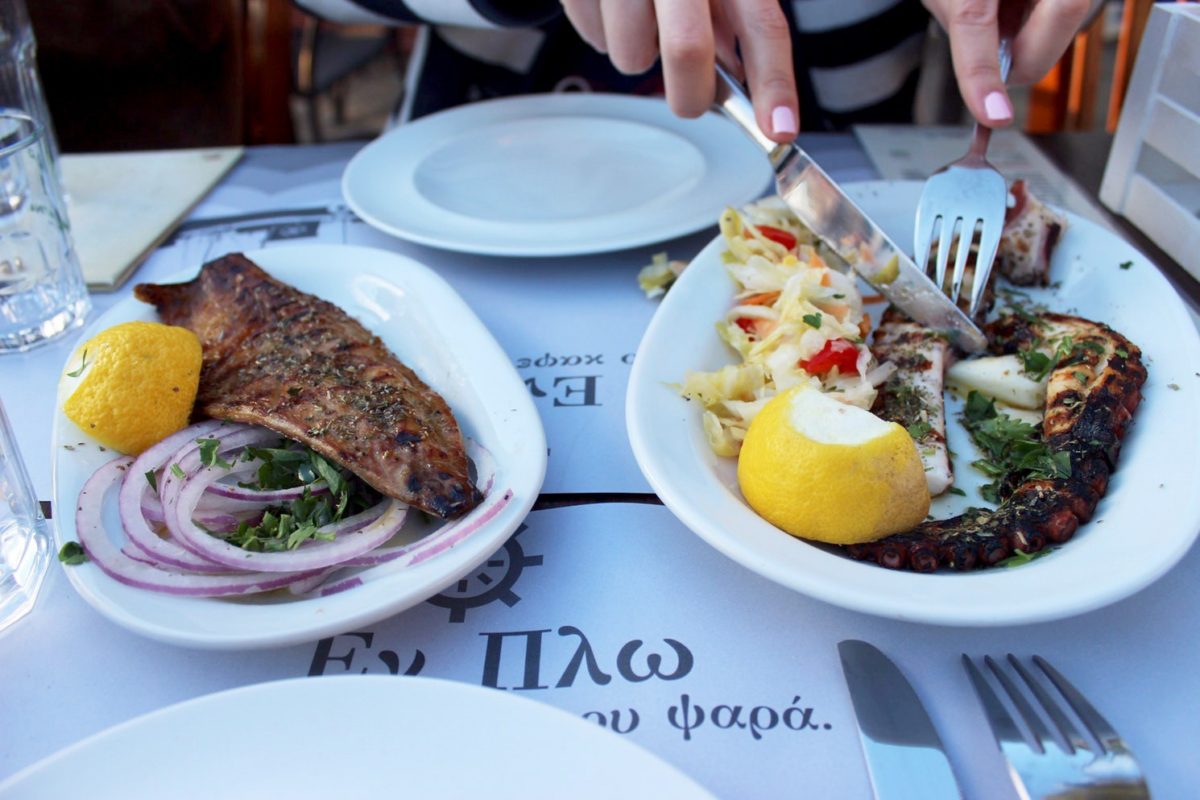
Fatty fish is one of the foods most closely associated with Mediterranean-style eating. Some of our favorites include salmon, sardines, mackerel, trout, and anchovies.
There is an important distinction to make when talking about fish and cholesterol. Fatty fish is not necessarily a superstar at directly lowering LDL cholesterol. Its real strength is its omega-3 fatty acids, particularly EPA and DHA.
Omega-3 fatty acids can help lower triglycerides, another type of fat found in the blood. But fish can also be beneficial because of what it replaces.
Imagine that one night each week you have salmon instead of sausage, a hamburger, or a fatty steak. You have replaced a food that may contain a significant amount of saturated fat with a food rich in unsaturated fats and omega-3s.
This is a good example of why simply calling a diet “low-fat” does not tell us very much. Butter contains fat. Salmon contains fat. Extra virgin olive oil contains fat. Walnuts contain fat. Yet these foods have very different nutritional profiles.
Instead of fearing all dietary fat, we want to pay attention to the type of fat we are eating and what foods those fats come from.
Try This Meal: Sheet Pan Salmon + Barley Salad
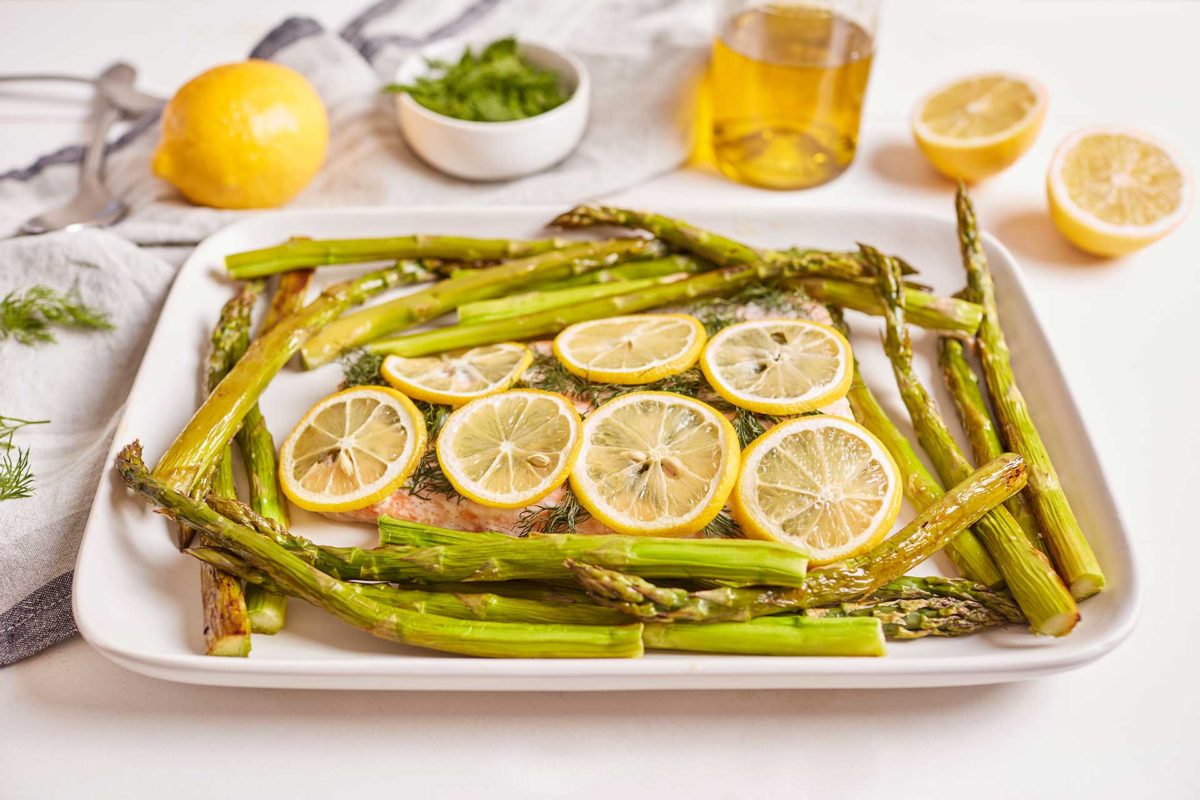
Sheet Pan Salmon with Asparagus, Lemon and Dill
This simple sheet pan dinner gives you fatty fish alongside asparagus, lemon, dill, and other classic Mediterranean flavors. It is an easy way to make fish part of your regular dinner rotation without creating a complicated meal.
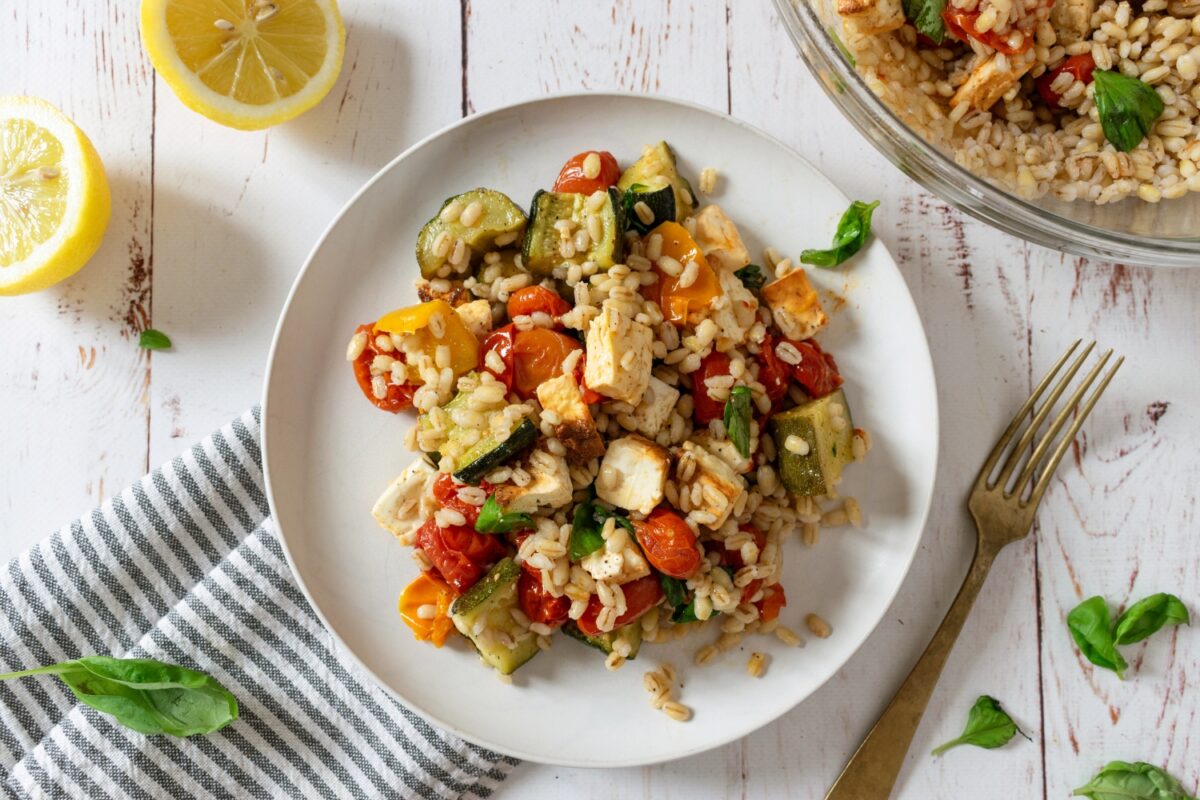
Barley Salad with Feta and Roasted Vegetables
Pair the salmon with this barley salad and suddenly we are stacking several heart-healthy foods together. The salmon provides EPA and DHA, while barley provides fiber, including beta-glucan. Add extra virgin olive oil, tomatoes, peppers, zucchini, asparagus, and herbs, and you have a meal filled with different beneficial foods rather than relying on one ingredient to do all the work.
#4: Whole Grains
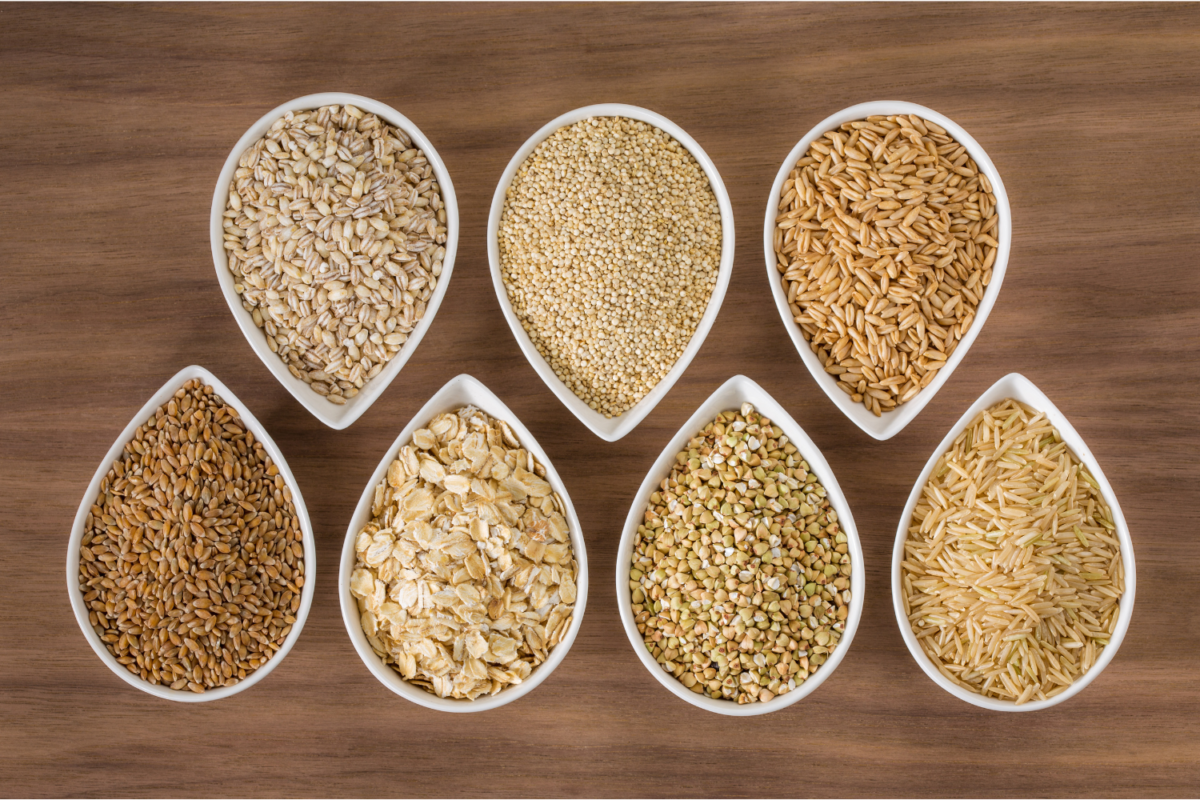
When people think about foods that help to lower cholesterol, oatmeal often comes to mind. There is a good reason for that. Oats contain beta-glucan, a type of soluble fiber.
But oatmeal is far from your only option.
Barley is another excellent source of beta-glucan, and the Mediterranean Diet gives us plenty of ways to enjoy whole grains such as barley, farro, bulgur, and whole-grain breads.
How Does Soluble Fiber Help Lower LDL?
We can keep the science fairly simple.
Soluble fiber forms a gel-like material in the digestive tract and can interfere with the reabsorption of bile acids. Your body uses cholesterol to make more bile acids, which can contribute to lower LDL cholesterol over time.
Whole grains also offer benefits beyond cholesterol. Their fiber can support digestive health and beneficial gut bacteria, help with fullness, and contribute to steadier blood sugar responses compared with many refined grains.
This is another reason we like the idea of swapping rather than simply removing foods. You do not have to stop eating grains. Try replacing some refined grains with intact or minimally processed whole grains.
Try This Meal: Farro Bowl + White Bean Salad
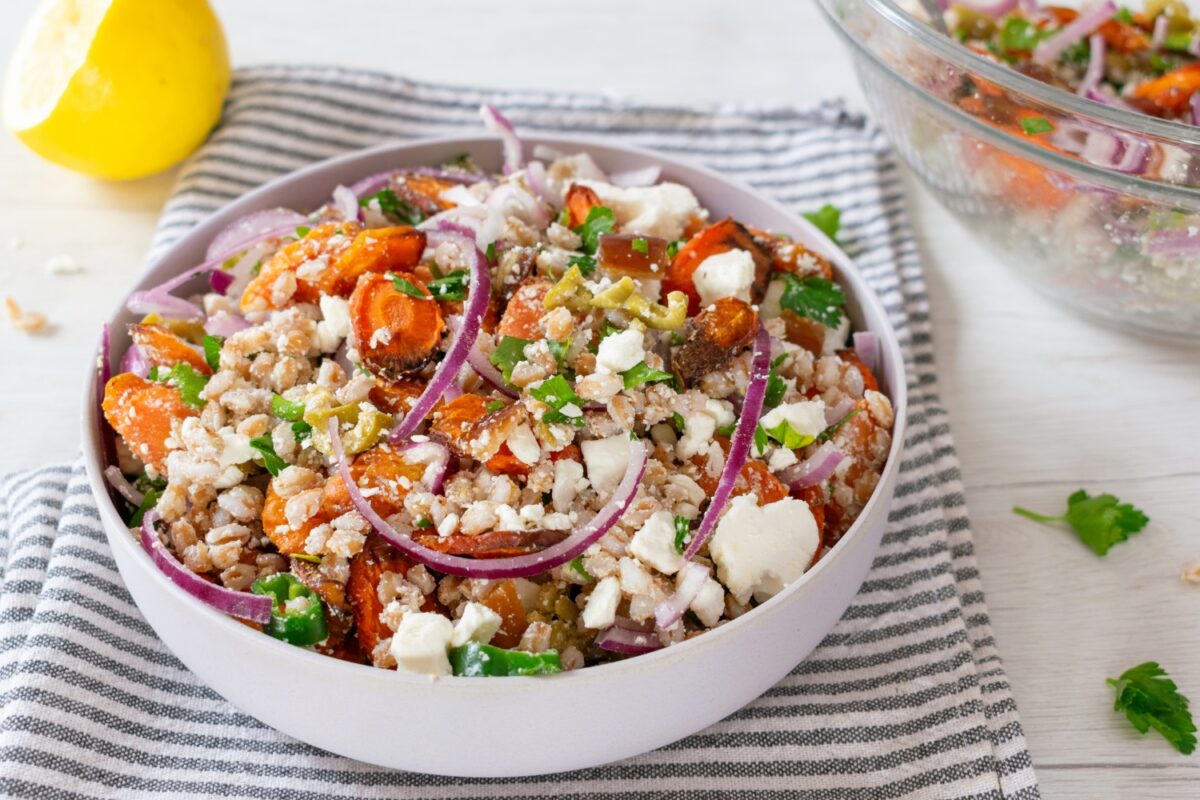
Farro Bowl with Roasted Carrots and Feta
Farro has a wonderfully chewy texture that makes a bowl feel substantial and satisfying. Pair it with roasted vegetables, herbs, and a little feta, and you have a simple way to make whole grains the foundation of a Mediterranean meal.
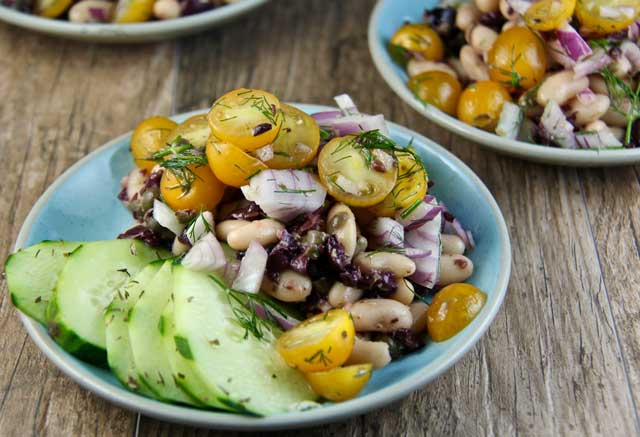
Olive Tapenade and White Bean Salad
Serve it alongside this white bean salad and we start stacking our cholesterol-friendly foods again. We have a whole grain, beans, vegetables, olives, and extra virgin olive oil all on the same plate.
This is a pattern you will see throughout this article. One food can be helpful. A whole meal built around these foods is even better.
#3: Extra Virgin Olive Oil
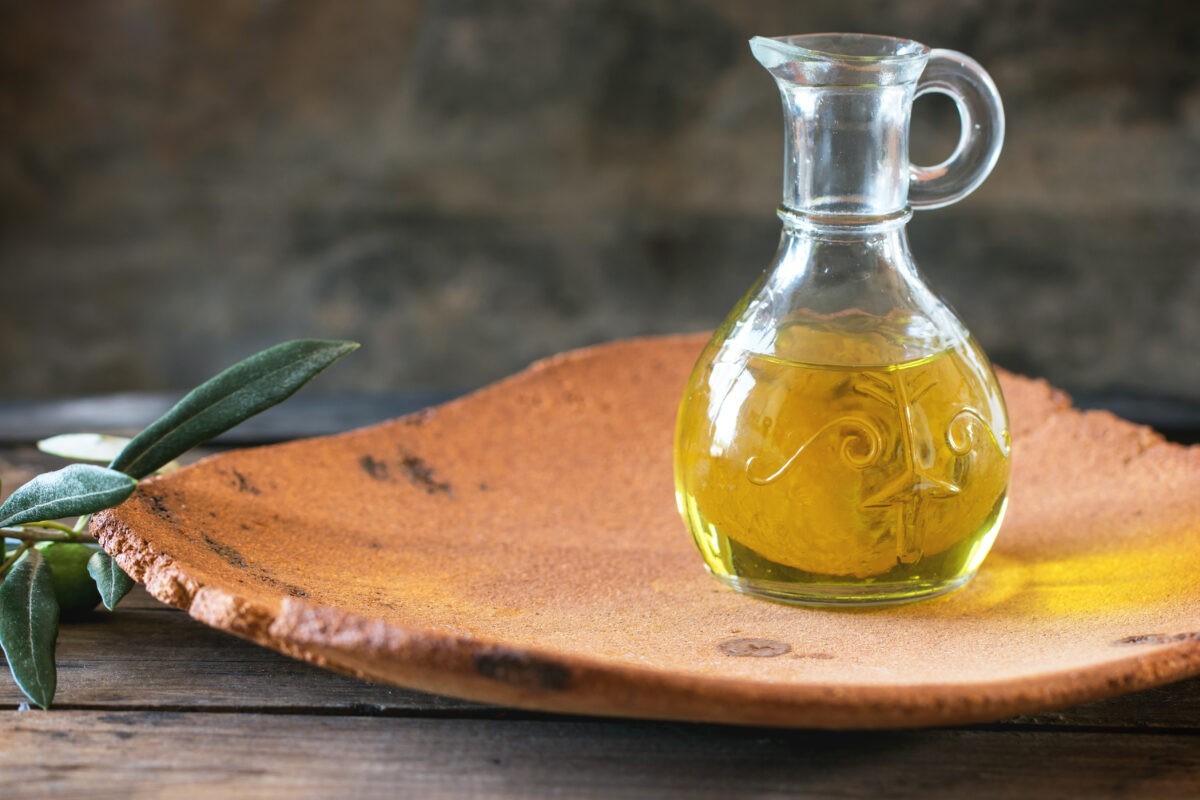
You probably knew this one was coming.
Extra virgin olive oil, or EVOO, is one of the foundations of the traditional Mediterranean Diet.
Olive oil is rich in monounsaturated fat. One of the biggest advantages comes when we use it to replace foods higher in saturated fat.
For example, you can cook vegetables with extra virgin olive oil instead of butter. You can dip whole-grain bread into olive oil rather than spreading it with butter. You can make a vinaigrette with olive oil rather than choosing a dressing dominated by saturated fat.
That replacement is important.
The message is not to eat exactly the same diet you eat now and pour half a cup of olive oil over everything. We want olive oil to become part of an overall shift toward more beneficial sources of fat.
Olive Oil Is More Than Monounsaturated Fat
Extra virgin olive oil also contains polyphenols. These are naturally occurring plant compounds with antioxidant and anti-inflammatory properties.
Researchers have studied several ways these compounds may contribute to cardiovascular health, including their potential role in protecting LDL particles from oxidative modification.
One of the most famous studies of the Mediterranean Diet is PREDIMED. The study included more than 7,000 adults at high cardiovascular risk. Participants assigned to Mediterranean dietary patterns supplemented with extra virgin olive oil or nuts experienced fewer major cardiovascular events than participants assigned to the control diet.
This is an important distinction. The ultimate goal is not simply lowering LDL on a blood test. We care about outcomes such as heart attacks, strokes, and cardiovascular health over the long term.
Try This Meal: Horta + Authentic Greek Salad
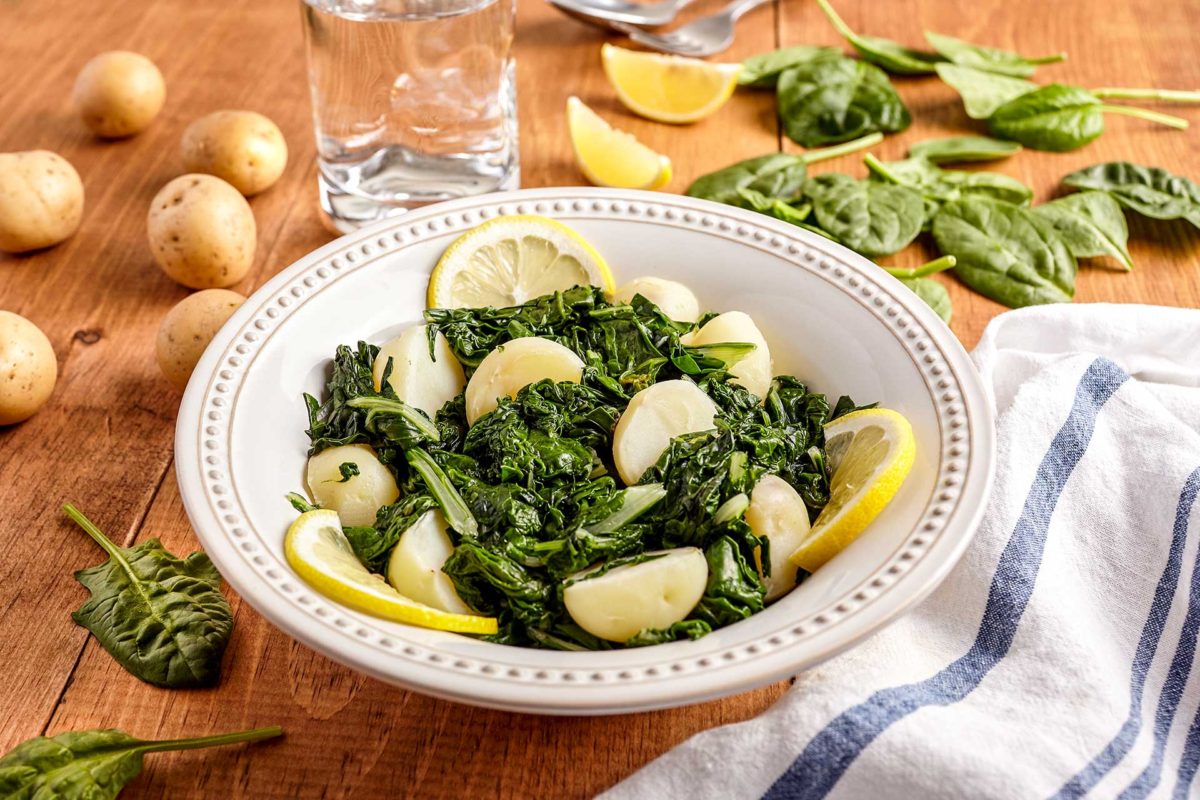
Horta — Greens with Potatoes
Horta is a beautiful example of how vegetables and olive oil work together in traditional Mediterranean cooking. Greens become something you genuinely want to eat when they are dressed with good olive oil, lemon, and other simple flavors.
Authentic Greek Salad
Pair those greens with an authentic Greek salad and you have tomatoes, cucumbers, vegetables, herbs, and plenty of flavor from extra virgin olive oil.
Something we have noticed while spending time in places such as Crete is that olive oil is not treated like a supplement. It is simply part of the food.
Greens get olive oil, garlic, and lemon. Tomatoes and cucumbers get olive oil and herbs. The olive oil makes vegetables taste amazing, which makes you want to eat more of them.
That may be one of the secret weapons of Mediterranean cooking.
#2: Beans and Lentils
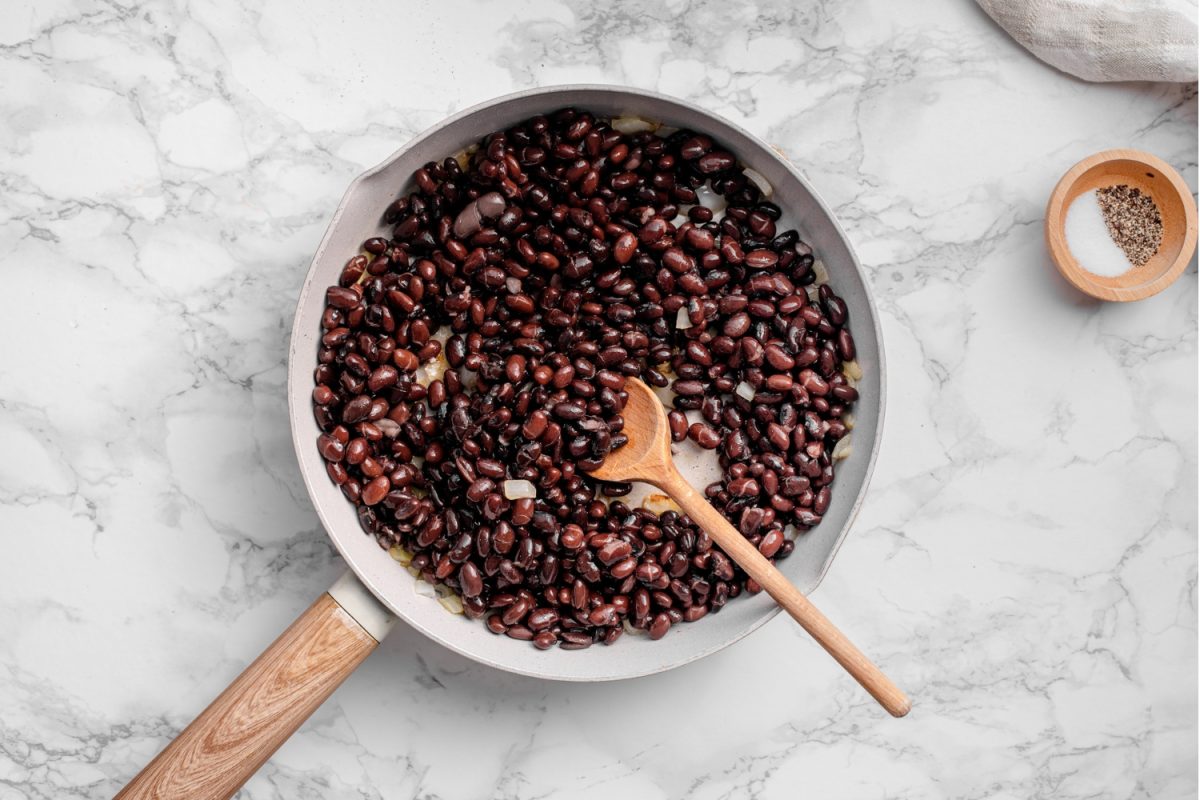
Lentils, chickpeas, cannellini beans, black beans, kidney beans, and fava beans are some of our favorite foods in the Mediterranean Diet.
They are inexpensive, filling, versatile, and excellent ingredients for anyone looking for foods that help to lower cholesterol.
1. Beans Provide Soluble Fiber
Beans and lentils give us another source of soluble fiber. As we discussed with whole grains, soluble fiber can help the body eliminate bile acids and can contribute to reductions in LDL cholesterol.
2. Beans Can Replace Meat
This is where the benefits get even more interesting.
Suppose you replace sausage with lentils in a meal. You are not merely removing something. You are making a nutritional trade.
You remove a food that may contain significant saturated fat and replace it with a food containing fiber, plant protein, and very little saturated fat.
That is a fantastic swap.
3. Beans Feed Your Gut Microbiome
Beans and lentils contain fiber and resistant starch that can feed beneficial bacteria in the gut. Those bacteria produce compounds that may influence several aspects of metabolic health.
Beans can also contribute to fullness and provide an inexpensive source of protein. You do not need an exotic powder or expensive supplement to make a heart-healthy change. Some of the most useful foods in the Mediterranean Diet cost only a couple of dollars a can.
Try This Meal: Lentil Soup + Greek Salad
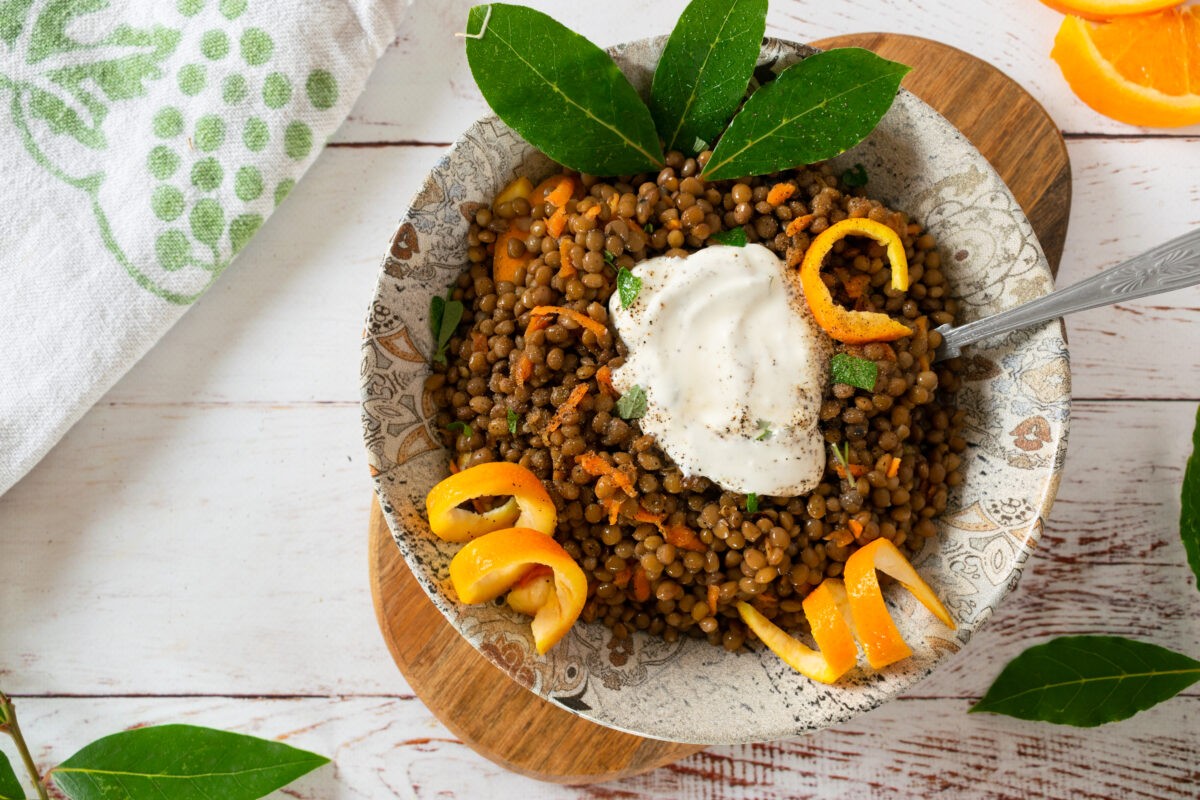
Mediterranean Lentil Soup with Olive Oil and Orange
This lentil soup is exactly the kind of food we mean when we talk about making heart-healthy eating sustainable. Lentils combine with olive oil, vegetables, onions, garlic, and plenty of flavor to create a meal that feels comforting rather than restrictive.
Authentic Greek Salad
Serve the soup with Greek salad and a small piece of whole-grain sourdough bread.
Now look at the plate. You have lentils, extra virgin olive oil, tomatoes, onions, garlic, vegetables, and whole grains.
It is also useful to think about what is not dominating the plate. There is no giant piece of meat covered in cheese. There is no need for sausage or steak to be the center of every meal.
That is the Mediterranean Diet in action.
#1: Nuts
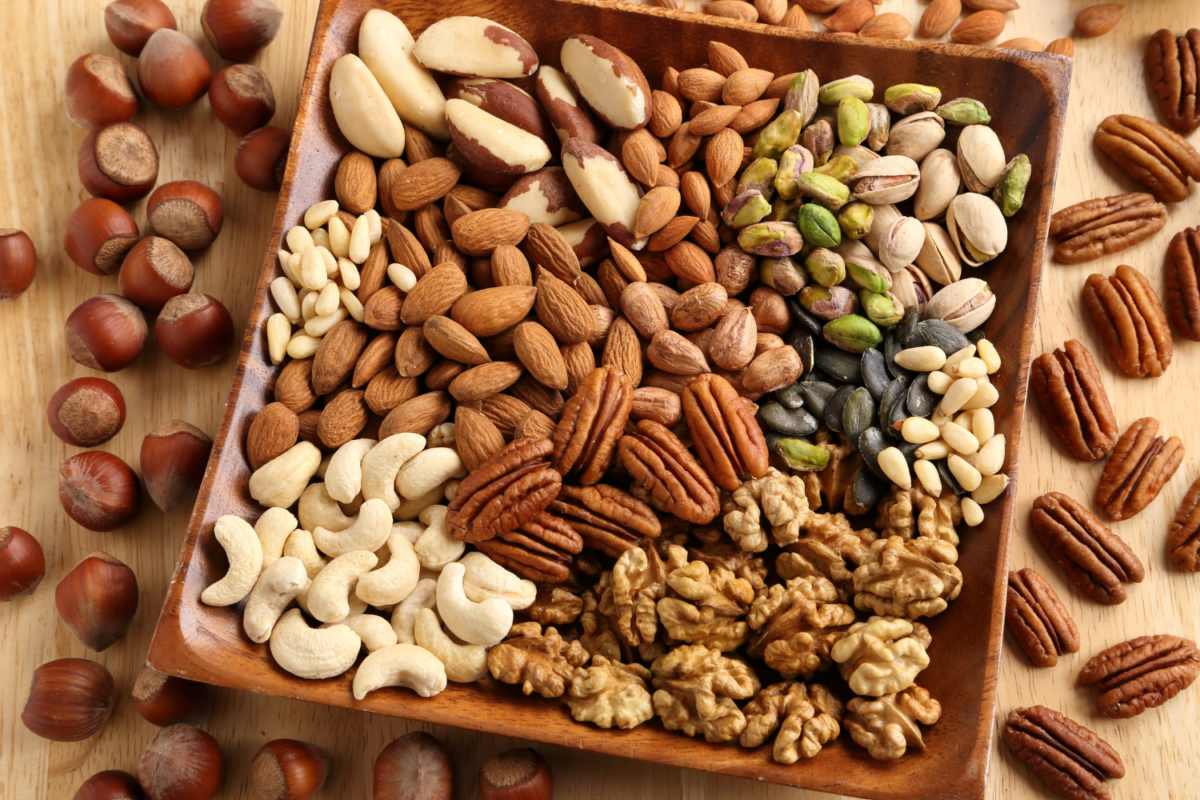
Our number one choice for lowering cholesterol is nuts, especially walnuts, almonds, and pistachios.
Nuts have been studied extensively for their effects on cardiovascular risk factors. They provide an impressive combination of unsaturated fats, fiber, plant sterols, protein, minerals, and polyphenols.
Studies have found that incorporating nuts into a healthy dietary pattern can contribute to improvements in LDL cholesterol, total cholesterol, and ApoB.
What Is ApoB?
We do not need to get overly technical here.
ApoB is a protein found on potentially atherogenic lipoprotein particles. Because each of these particles carries one ApoB molecule, measuring ApoB can give us useful information about the number of potentially harmful cholesterol-carrying particles circulating in the blood.
Nuts Give Us Several Benefits in One Food
The plant sterols found naturally in nuts can help reduce intestinal cholesterol absorption. Nuts are also rich in beneficial unsaturated fats, and walnuts are particularly notable because they provide alpha-linolenic acid, or ALA, a plant-based omega-3 fatty acid.
And once again, think about replacement.
Imagine your usual 3 p.m. snack is cookies. Instead, you have a small handful of walnuts and an apple.
Those two snacks have completely different nutritional profiles.
But Aren’t Nuts High in Calories?
Yes. Nuts are calorie dense.
However, they are also satisfying, and research does not suggest that reasonable portions of nuts automatically lead to the amount of weight gain you might expect based only on their calorie content.
You do not need to eat the entire bag. A small handful can be an easy practical way to make nuts part of your daily routine.
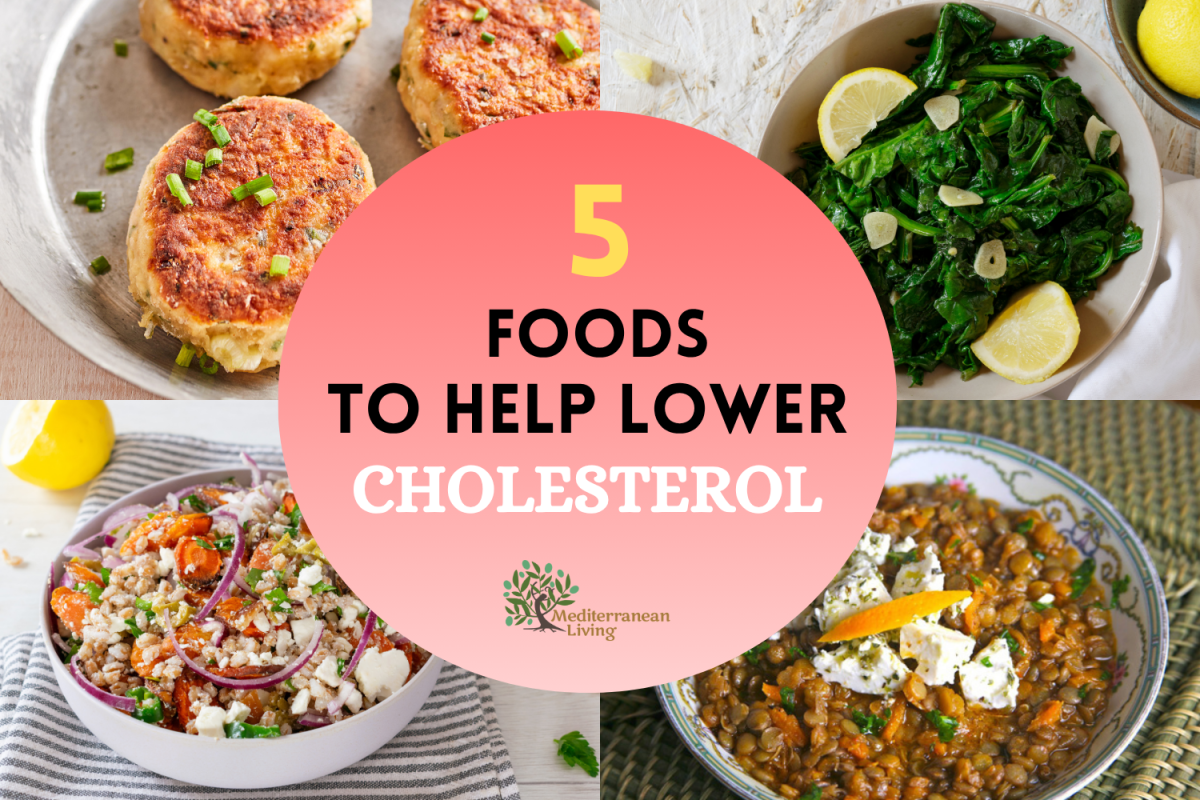
Try This Meal: Tuna Patties + Apple Walnut Salad + Spinach
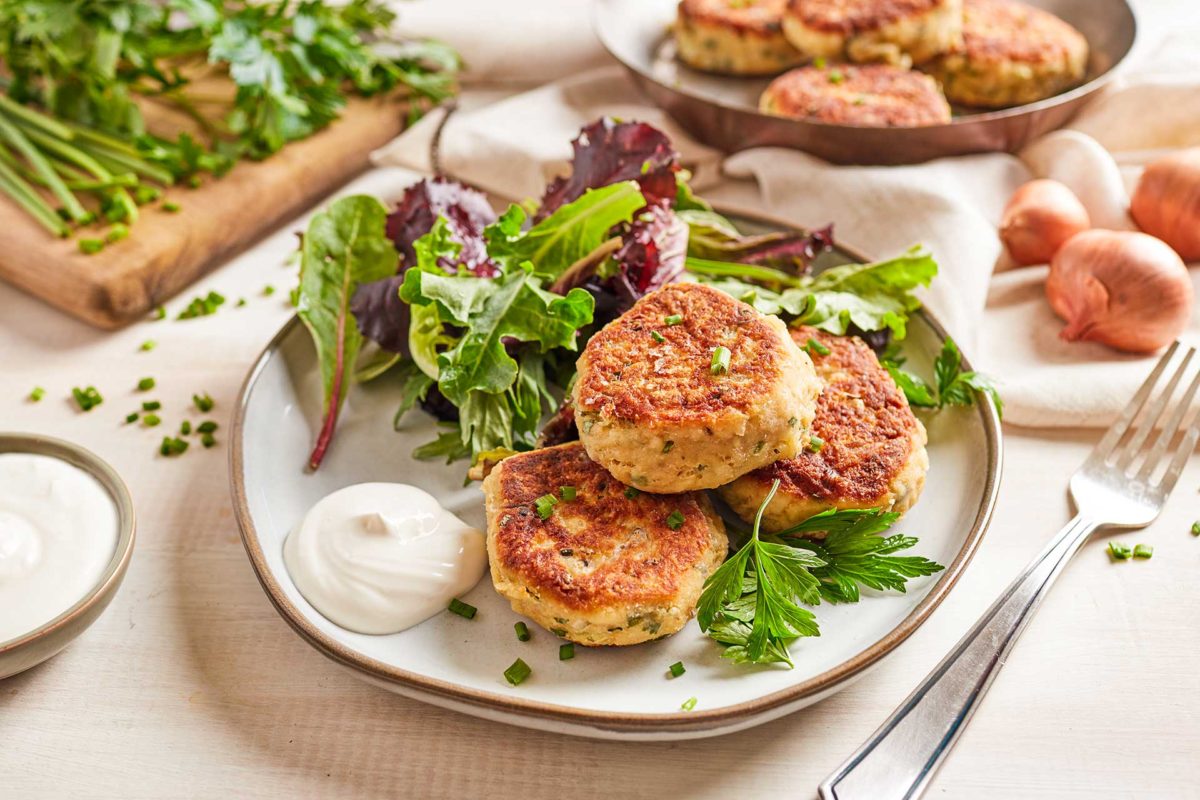
Tuna Patties Fried in Olive Oil
These tuna patties give the meal a satisfying source of protein while continuing our theme of using olive oil and seafood in place of foods that may be higher in saturated fat.
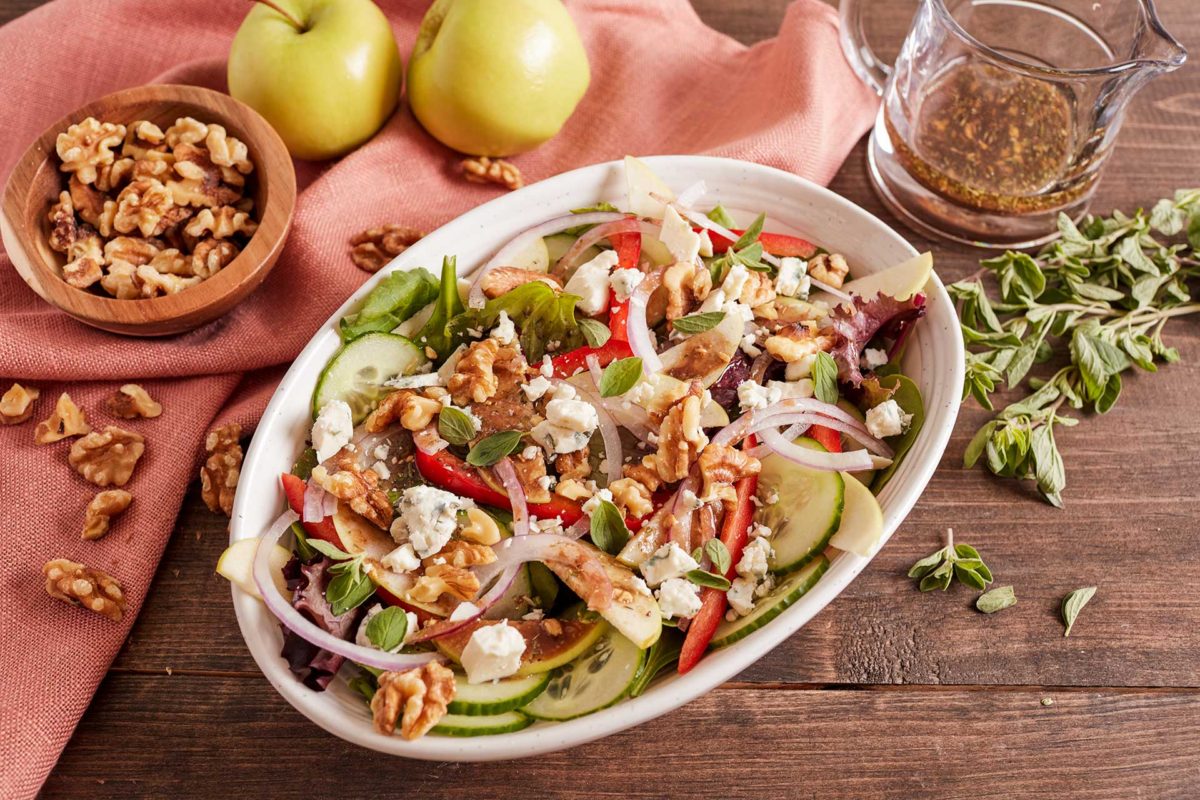
Apple, Walnut and Gorgonzola Salad with Dijon Vinaigrette
This salad gives us our walnuts along with apple, greens, and a flavorful vinaigrette. It is a great example of how nuts can become part of a meal instead of something you only eat by themselves.
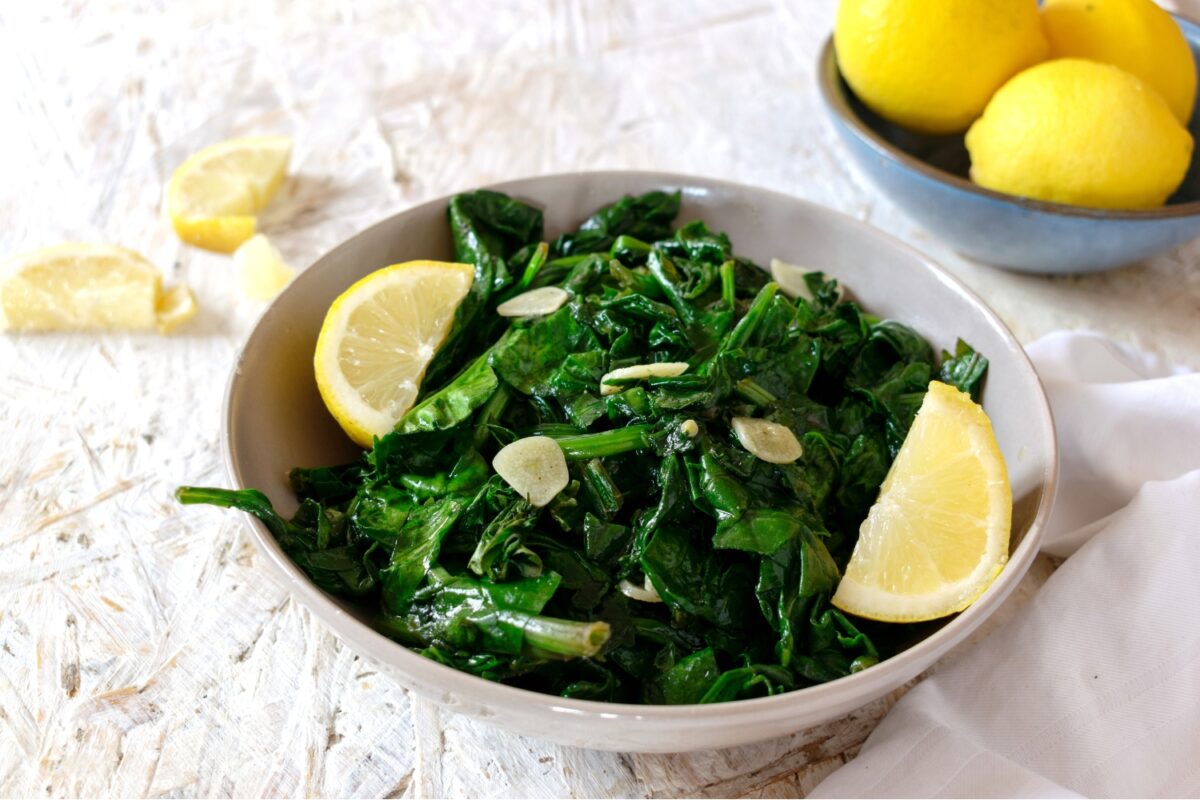
Sautéed Spinach with Lemon
Add sautéed spinach with lemon and look at the complete meal: walnuts, tuna, leafy greens, apple, extra virgin olive oil, fiber, plant sterols, polyphenols, and unsaturated fats.
Again, there is no single magic ingredient here. The foods complement one another.
And notice something else: this is not a low-fat meal.
Walnuts are not heart healthy because they are low in fat. Extra virgin olive oil is not beneficial because it is low in fat. The important distinction is that we are emphasizing beneficial unsaturated fats while reducing some of the foods that contribute larger amounts of saturated fat.
What Happens When We Put All Five Foods Together?
We do not want you to finish this article thinking, “Nuts are number one, so I’ll eat five walnuts every day and I’m done.”
That misses the bigger point.
The real power comes from combining these foods into an overall eating pattern and doing it consistently.
A day might look something like this:
- Breakfast: Whole-grain bread with extra virgin olive oil and avocado
- Lunch: Lentil soup or a bean salad
- Snack: Walnuts and fruit
- Dinner: Salmon with vegetables and barley
Across the day, you are getting soluble fiber, plant sterols, omega-3 fatty acids, polyphenols, unsaturated fats, food for beneficial gut bacteria, and a wide variety of plant foods.
At the same time, those foods naturally begin to displace some of the butter, processed meat, refined grains, and highly processed snacks that might otherwise take their place.
It Is Not Really Just About Cholesterol
At the end of the day, we are not eating this way simply to get a better number the next time we have blood drawn.
We are trying to build an eating pattern that supports our cardiovascular and metabolic health over the long term.
That means thinking about LDL cholesterol, but also triglycerides, blood pressure, blood sugar, artery health, body weight, and ultimately our risk of cardiovascular disease.
This is one of the reasons the Mediterranean Diet feels so different from old-fashioned “heart diet” thinking.
You do not need to be afraid of food. You do not need to live on plain steamed vegetables. You do not need to eliminate every food containing cholesterol. And you certainly do not need to eliminate all fat.
Instead, think about swaps:
- Butter → extra virgin olive oil
- Red and processed meats → beans, lentils, and fish more often
- Refined grains → whole grains
- Cookies and chips → nuts and fruit
- And keep adding vegetables and other plant foods wherever you can
The Bottom Line: Focus on the Whole Plate
The best foods that help to lower cholesterol are not magic ingredients that need to be eaten in isolation.
Fatty fish gives us omega-3 fatty acids. Whole grains and beans provide soluble fiber. Extra virgin olive oil and nuts provide beneficial unsaturated fats. Nuts also contribute plant sterols, fiber, and polyphenols. Vegetables, fruits, herbs, and other plant foods add even more variety.
Put these foods together consistently and you begin to create something much more powerful: an overall Mediterranean eating pattern.
We are not simply taking foods away. We are replacing them with delicious foods that can support our hearts and make meals more enjoyable at the same time.
That is the approach we want to be able to follow not just for a week or a month, but for years to come.
If you have high cholesterol, cardiovascular disease, or take cholesterol-lowering medication, dietary changes should complement rather than replace individualized medical care. Talk with your doctor or a registered dietitian about the approach that makes sense for you.


Winter LeBlanc says:
Bill Bradley, R.D. says:
Bill Bradley, R.D. says: